
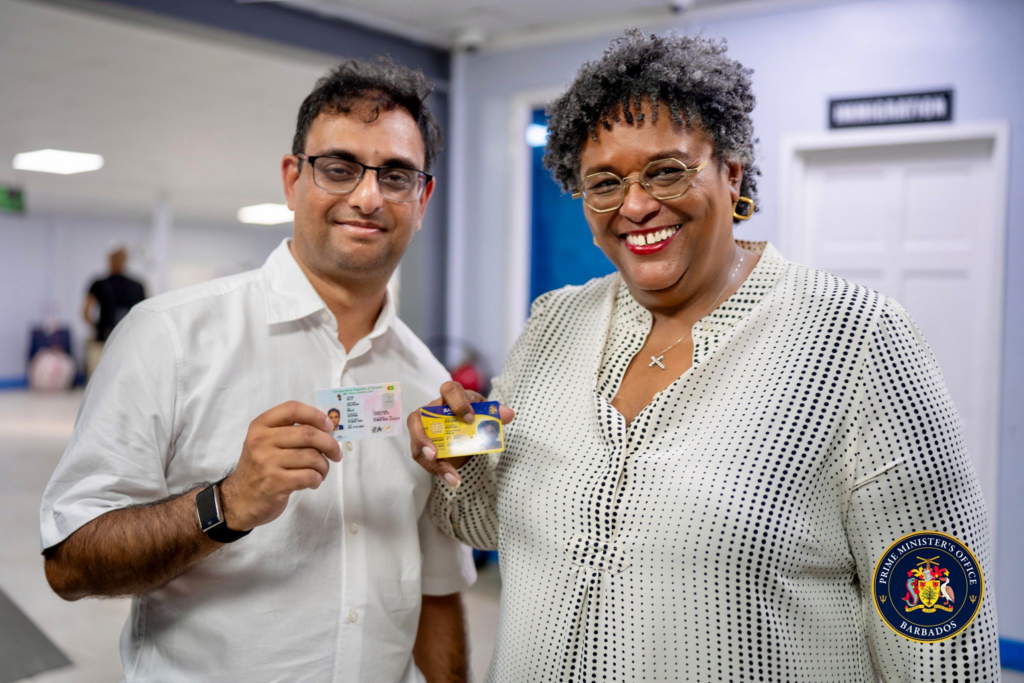
Photo courtesy: Prime Minister’s Office of Barbados
Port of Spain, Trinidad and Tobago – 27th May 2026 – The Caribbean Telecommunications Union (CTU) extends warm congratulations to the Governments of Barbados and Guyana on their landmark decision to permit citizens of both countries to travel using national identification cards beginning 1st July 2026. The initiative represents an important and practical step toward deeper regional integration and a more connected Caribbean community. The arrangement will allow eligible citizens to travel between the two countries without the need for passports, utilising secure national identification systems instead.
The Secretary-General of the CTU, Rodney Taylor, welcomed the development as a significant advancement toward the realisation of the Caribbean’s vision of a seamless digital future.
“This is an important milestone for regional integration and one that demonstrates how technology can tangibly improve the daily lives of Caribbean citizens. The CTU applauds Barbados and Guyana for taking a bold and innovative step that brings our region closer to the vision of the CARICOM Single ICT Space and ultimately one digital Caribbean community.”
The CTU noted that digital identity systems are increasingly becoming foundational building blocks for national digital transformation strategies. Secure and trusted digital identities create opportunities far beyond travel facilitation. They support more efficient delivery of government services, financial inclusion, e-commerce, secure online transactions, digital public services, and greater participation in the digital economy.
The Barbados-Guyana initiative demonstrates how digital identity can move from being a domestic administrative tool to becoming a practical enabler of regional mobility and economic cooperation. It also illustrates how technology can strengthen people-to-people connections and reduce friction in regional movement.
“The Caribbean Single ICT Space is not solely about networks and infrastructure; it is fundamentally about enabling people to move, transact, communicate and participate more easily across borders,” Taylor added. “Digital identity is a foundational element of this vision. We encourage CTU Member States to continue advancing the implementation of trusted digital identity systems as part of their broader digital transformation agendas.”
The CTU further encouraged governments across the region to leverage digital technologies in ways that support Caribbean unity, social inclusion, and economic development, while ensuring that systems are designed with strong cybersecurity protections, privacy safeguards and interoperability standards.
“As our region continues its digital journey, we should embrace technologies that create safe and seamless experiences for Caribbean citizens. This initiative demonstrates what is possible when innovation, cooperation and regional vision come together.”
Mr. Carlos Vargas, Lead Expert for the EU-LAC Digital Alliance at the e-Governance Academy, also commended the initiative by Barbados and Guyana, noting that it demonstrates the practical benefits of cross-border interoperability and trust frameworks for citizens.
He stated, “The decision by Barbados and Guyana to enable travel using national ID cards is a great example of how interoperability and trust frameworks can benefit citizens. Through the EU-LAC Digital Alliance, we have focused on cross-border interoperability and identification by providing practical tabletop exercises and creating a Common Reference Framework. We are even more motivated to see now concrete use cases emerging, which demonstrate the growing momentum toward interoperable, secure and trusted digital cooperation across the LAC region.”
The CTU reaffirmed its commitment to supporting its Member States in the development of policies, frameworks and initiatives that advance digital transformation and contribute to the realisation of a secure, inclusive and integrated Caribbean digital ecosystem.