
Porto, Portugal | 2nd to 3rd February 2026
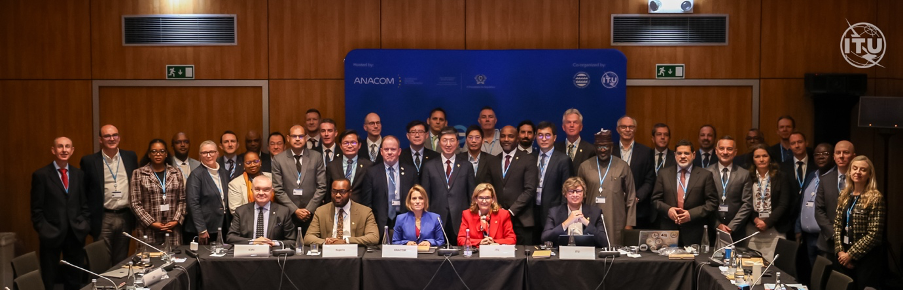
Family photo: International Submarine Cable Resilience Summit 2026
Governments, industry representatives and international organisations from over 70 countries convened in Porto, Portugal, at the International Submarine Cable Resilience Summit 2026 to reaffirm the vital role of submarine telecommunications cables as critical infrastructure underpinning global connectivity, economic development, social inclusion and digital transformation. Secretary-General Rodney Taylor represented CTU Member States at the Summit.
The Summit culminated in the adoption of the Porto Declaration on Submarine Cable Resilience, affirmed on 3rd February 2026 by the International Advisory Body on Submarine Cable Resilience (IAB), established in 2024 under the joint leadership of the International Telecommunication Union (ITU) and the International Cable Protection Committee (ICPC).
The Porto Declaration builds upon the Abuja Declaration (February 2025), reaffirming principles and priorities recognising submarine telecommunications cables as critical infrastructure and advancing non-binding recommendations designed to strengthen international cooperation and resilience.
Submarine telecommunications cables carry more than 99 per cent of international data traffic. Approximately 500 cables spanning over 1.7 million kilometres form the backbone of global digital communications. With more than 200 cable faults reported annually, disruptions have significant economic, governmental and societal consequences, particularly for Small Island Developing States (SIDS), including those in the Caribbean.
The Porto Declaration: Overarching Guidance
Through the Porto Declaration, members of the International Advisory Body on Submarine Cable Resilience reaffirmed their shared commitment to:
- Harmonising and strengthening policy and regulatory environments that support development, operation and resilience of submarine cable systems;
- Reducing barriers that delay deployment and restoration;
- Enhancing coordination among governments, regulators, maritime authorities and industry stakeholders;
- Building institutional capacity and technical expertise;
- Encouraging investment, geographic diversity and redundancy, especially for SIDS and underserved regions;
- Promoting industry best practices for risk assessment, mitigation and response; and
- Strengthening cable protection and marine spatial planning coordination.
The Declaration invites governments to reflect this guidance in national and regional policies and encourages industry to expand initiatives supporting cable protection and resilience.
Key Recommendations affirmed in Porto
Consistent with the Porto Declaration, the following priority areas were emphasised:
1. Streamlined Permitting and Repair Processes
- Establish clear, transparent and predictable regulatory frameworks.
- Designate a national Single Point of Contact (SPOC) to facilitate deployment and emergency repairs.
- Reduce regulatory barriers in areas such as cabotage, customs procedures and marine spatial planning.
- Expand repair assets, maintenance cooperation and spare pooling.
- Encourage long-term maintenance arrangements and public–private partnerships in underserved regions.
For Caribbean SIDS, where repair vessels may require extended transit times, these measures are essential to reducing outage durations and economic losses.
2. Legal and Regulatory Strengthening
- Improve legal frameworks to recognise submarine cables as critical infrastructure.
- Implement obligations under the United Nations Convention on the Law of the Sea (UNCLOS), including Article 113 concerning protection against intentional damage.
- Develop national risk strategies informed by fault and vulnerability data.
- Establish voluntary standardised reporting mechanisms.
- Conduct stress tests and resilience audits.
Given the Caribbean’s exposure to hurricanes, seismic risks and high maritime traffic corridors, coordinated enforcement and hazard assessment are imperative.
3. Geographic Diversity and Investment Support
- Encourage cable route diversity and redundant landing points.
- Support blended-finance platforms and PPP models and investments in de-risking projects in SIDS.
- Facilitate non-discriminatory access to landing stations.
- Integrate branching units in trunk routes to enhance cost-effective connectivity.
- Develop resilient backup arrangements, including satellite and microwave failover solutions.
For Caribbean States with limited international links, geographic redundancy is foundational to economic continuity, digital public services and national security.
Implications for the Caribbean
The Porto Declaration is particularly relevant for Caribbean Small Island Developing States. While their individual markets are small, collectively the Caribbean represents a significant regional digital ecosystem dependent on resilient, redundant and secure international connectivity.
To be in alignment with the Porto Declaration, the CTU Member States region must:
- Harmonise regulatory frameworks to accelerate permitting processes;
- Explore regional repair cooperation and shared maintenance hubs;
- Advance innovative financing models for diversified routes;
- Strengthen cable protection legislation in line with UNCLOS obligations; and
- Develop coordinated failover strategies integrating submarine, satellite and terrestrial infrastructure.
The Caribbean Telecommunications Union reaffirms its commitment to working with Member States, regulators, operators and international partners to reflect the guidance of the Porto Declaration within regional policy frameworks and to advance cooperative mechanisms that strengthen resilience.
Through this alignment, the CTU Member States contribute to the shared global commitment affirmed in Porto: ensuring submarine cables remain a resilient foundation of open, reliable and interoperable global connectivity for all.