
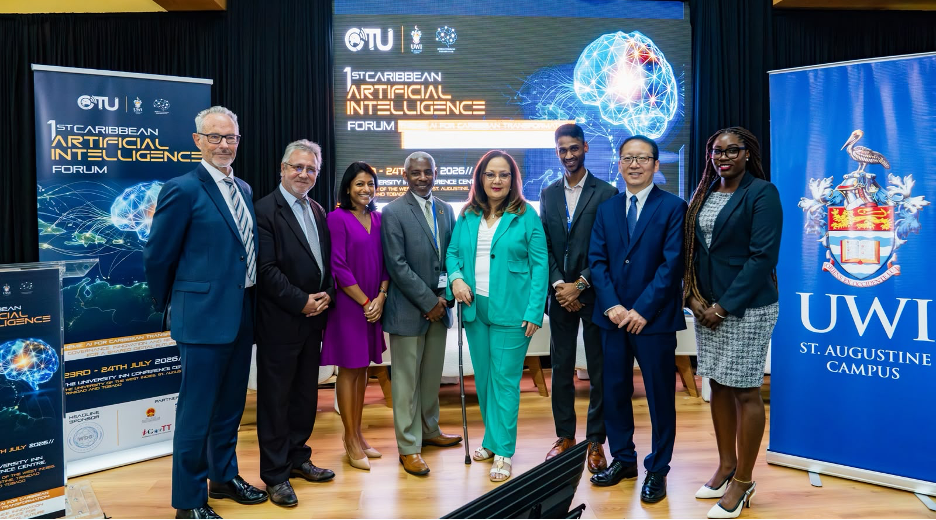
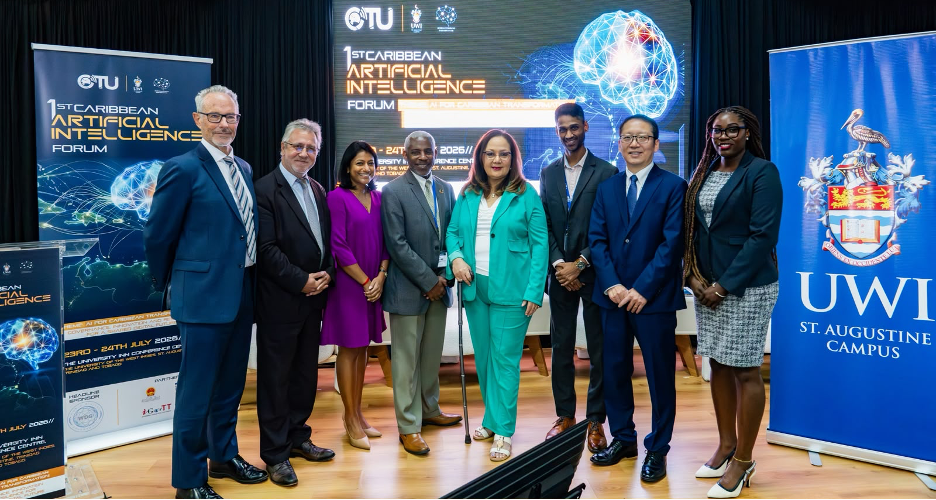
From left to right: Mr. Graeme Thomson, Founding Member, World Digital Governance (WDG); H.E. Guillaume Pierre, Ambassador of the French Republic to Trinidad and Tobago; Ms. Jaya Ramoutar, Executive Portfolio Manager, Project Management Office, Ministry of Public Administration and Artificial Intelligence; Mr. Nigel Cassimire, Deputy Secretary-General and Head of Regional Policy Development, CTU; Prof. Rose‑Marie Belle Antoine, Campus Principal, UWI STA Campus; Dr. Craig Ramlal, Executive Director of the Artificial Intelligence Innovation Centre and Head of the Control Systems Group in the Department of Electrical and Computer Engineering, University of the West Indies, St. Augustine and Chair, CTU Caribbean AI Task Force; H.E. Ren Hongyan, Ambassador of the People’s Republic of China to Trinidad and Tobago; and Ms. Lois St. Brice, Senior Programme Officer – Strategic Partnerships and Initiatives Office of global affairs Office of the Vice-Chancellor, UWI
St. Augustine, Trinidad and Tobago – 23rd July 2026 – The Caribbean Telecommunications Union (CTU), in partnership with The University of the West Indies (UWI) St. Augustine Campus and the Artificial Intelligence Innovation Centre (AIIC), today officially opened the 1st Caribbean Artificial Intelligence Forum (CAIF) 2026, bringing together regional and international leaders, policymakers, academics, innovators, development agencies, youth representatives and private sector stakeholders to advance the responsible development and adoption of artificial intelligence across the Caribbean. The Forum is being held from 23rd – 24th July 2026 under the theme “AI for Caribbean Transformation: Governance, Innovation and Resilience for a Shared Digital Future.”
The landmark event marks a significant milestone in the Caribbean’s digital transformation journey and provides a platform for dialogue, collaboration and action. A key feature of the Forum is the launch of the Caribbean AI Task Force Report (CAITF), which outlines recommendations to guide regional AI policy and implementation. The Forum also addresses critical issues including AI governance, cybersecurity, data sovereignty, innovation, education, ethics, climate resilience and economic development.
During the opening ceremony, speakers underscored the importance of regional collaboration, responsible AI governance and sustained investment in innovation, education and capacity development to ensure that the Caribbean fully benefits from the opportunities presented by artificial intelligence.
Representing Senator the Honourable Dominic Smith, Minister of Public Administration and Artificial Intelligence of Trinidad and Tobago and President of the Caribbean Telecommunications Union, Ms. Jaya Ramoutar, Executive Portfolio Manager, Project Management Office, Ministry of Public Administration and Artificial Intelligence, reaffirmed the Caribbean’s tradition of regional cooperation and called for that same spirit to guide the region’s approach to AI and digital transformation.
“The Caribbean has never succeeded by acting alone. Our greatest advances have always been achieved through regional cooperation. Across generations, Caribbean nations have advanced through collaboration, shared institutions, common advocacy, and a deep understanding that small states can exercise meaningful influence when we coordinate our efforts.” She continued, “That same spirit must now guide our approach to AI and digital transformation. The future we seek must be one of shared development, shared capability and shared success.”
Speaking during the opening ceremony, Mr. Nigel Cassimire, Deputy Secretary-General of the Caribbean Telecommunications Union, emphasised the need for a structured regional framework to guide the responsible development and implementation of AI.
“AI must be harnessed to reduce our vulnerabilities and amplify our strengths. That requires a forum that sets the pace and the structure for action: standards that fit our scale, governance that protects our citizens, capacity development pathways that keep talent in the region, and financing models that help make pilot projects sustainable and scalable.”
Professor Rose-Marie Belle Antoine, Campus Principal of The University of the West Indies, St. Augustine Campus, highlighted the University’s longstanding leadership in artificial intelligence and reaffirmed its commitment to advancing innovation and scholarship in support of the region’s digital future.
“As a regional university, we have always been committed to advancing knowledge in service of society. Indeed, some of you may not be aware, but our Campus has a proud and longstanding history of leadership in AI that stretches back decades. Long before the global surge in interest in AI, the Faculty of Engineering hosted the Caribbean’s first AI conference in 1989, establishing a foundation for innovation and scholarship that continues to this day.”
Addressing participants on the work of the Caribbean AI Task Force, Dr. Craig Ramlal, Chair of the Caribbean AI Task Force and Executive Director of the Artificial Intelligence Innovation Centre, emphasized that regional cooperation is essential to building a competitive and resilient Caribbean AI ecosystem.
“The Caribbean cannot afford to remain on the sidelines of the AI revolution. Our markets may be small individually, but together we have the scale to develop harmonised AI policies, strengthen regional innovation, protect our data sovereignty and build an AI ecosystem that reflects Caribbean priorities. The work of the Caribbean AI Task Force demonstrates that regional cooperation is not simply desirable—it is essential if the Caribbean is to compete and thrive in the global digital economy.”
Delivering the keynote address, Mr. Graeme Thomson, Founding Member of World Digital Governance (WDG), called for bold regional cooperation to strengthen digital transformation, build shared capabilities and amplify the Caribbean’s voice in global digital governance.
“The future belongs to those who think boldly and organise intelligently and together. Sovereignty and cooperation are not opposites. The coming of artificial Intelligence and digital transformation are challenges too big for us to tackle alone. Only together can we educate a regional workforce can we build interoperable digital services and the infrastructure underpinning them. And only together can we shape international conversations to our interests. This is not surrendering sovereignty. It is exercising sovereignty intelligently.”
Over the next two days, participants will engage in a series of high-level discussions and expert panels examining AI governance for small states, national AI initiatives, intellectual property and creativity, data sovereignty and cybersecurity, ethical AI, women in AI, AI literacy and workforce development, climate resilience and disaster risk reduction, and AI-driven economic transformation.
The Forum is expected to generate actionable recommendations to support policy harmonisation, foster innovation, strengthen regional capacity and position the Caribbean as a leader in the responsible and inclusive development of artificial intelligence.
For more information on the CTU and its initiatives, please visit www.ctu.int
— END —
Get in touch: Facebook | Twitter | LinkedIn | YouTube | Instagram